

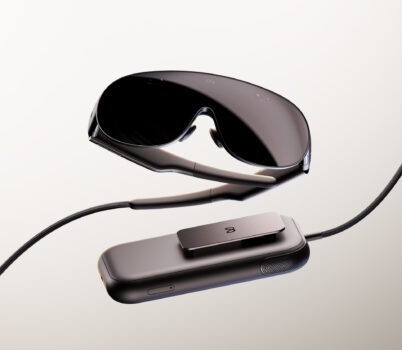
Meta VR Glasses. (Image courtesy Meta.)
Meta, the company that has lost more than $92 billion on virtual reality since 2020, will start selling its new VR glasses next spring for $1,299.99, the company announced yesterday at its annual Connect conference.
The glasses weigh about 100 grams — almost 4 ounces — or “roughly the same as a deck of cards,” Meta said in the announcement.
This is the device, codenamed Project Phoenix, that leaked out of Meta’s own software earlier this month. Its official name is Meta VR Glasses.
The glasses handle the displays and sensors, while a separate puck, connected by an optical tether, holds the processor, battery, and storage, and clips to a pocket or bag, Meta said in a blog post. The displays are micro-OLED and the processor is Qualcomm’s new Snapdragon Reality Elite. The puck battery lasts up to three hours of continuous high-resolution video.
The glasses have a 70-degree horizontal field of view, Engadget’s Devindra Hardawar reported. That’s narrower than the 100 degrees on Apple’s Vision Pro, Hardawar said, but “significantly higher than most display glasses.”
Users control the glasses with their eyes, hand gestures, and voice, and Meta’s AI agent is built right into the operating system, according to the blog post.
No controllers are needed, but the glasses are fully compatible with Meta’s Touch Plus controllers, the company said.
Prescription inserts are sold separately, according to the product page.
Lighter than the leak, pricier than the rumors
A few things turned out differently than the leaks suggested.
The glasses came in at about 100 grams, down from the reported 110 grams.
And the price is higher. The Wall Street Journal had reported that Meta was aiming for under $1,000.
The launch date, however, held. Meta had already pushed the glasses back to the first half of 2027, according to Business Insider.
Less metaverse, fewer headsets
Meta CEO Mark Zuckerberg didn’t get to the VR glasses until nearly 40 minutes into his keynote, after new AI glasses, a hearing enhancement feature, and a lot of talk about AI agents.
“Reality Labs is now focused on building great glasses for Muse and AI,” Zuckerberg said in the keynote. “And we made the decision to focus a little bit less on metaverse for now, you know, build fewer VR devices and only release them when we have real breakthroughs.”
The audience laughed.
“This is a breakthrough,” Zuckerberg said, about a minute before revealing the glasses.
Earlier in the keynote, Zuckerberg said that when Meta started building glasses, the company thought the metaverse would come first, and advanced AI would come later.
“But now it is actually quite clear that personal superintelligence will not only come first, it will be much bigger and more important,” he said.
By my count, the word “metaverse” came up exactly twice in the 55-minute keynote, and both times it was something Meta was stepping back from. Horizon Worlds, which Meta announced it was pulling from VR in March before partially reversing course, didn’t come up at all.
The one social feature was hologram calling. Users show up as photorealistic avatars, with real-time facial expressions, in any calling app, including WhatsApp and Zoom, according to Meta’s announcement.
“For the first time in VR, these are full-body holograms,” Meta CTO Andrew Bosworth said on stage. “We have finally solved the truly very hard problem of giving you legs in VR.”
If you missed the joke, Horizon Worlds avatars were famously legless for years.
So is this VR or not?
So is Meta getting back into VR, or is this a graceful way out?
Personally, I think it’s a little of both.
These are definitely VR glasses. They run the entire Quest library, and Bosworth played a new hands-only version of Beat Saber on stage.
“VR gaming is alive and well on Meta VR glasses,” Bosworth said.

But most of the pitch is about watching things. Meta calls the device “a personal cinema, courtside seat, workspace, and gaming console.” It’s the first VR device to be IMAX Enhanced certified, Disney+ is adding 3D movies in select countries in November, and there will be more than 100 immersive live sports events a year from partners like MLB, NBC Sports, and UFC, according to the announcement.

There’s nothing about virtual worlds. Nothing about building things, or hanging out with other people in a shared space — other than those holograms.
That’s an Apple Vision Pro strategy, not a metaverse strategy — and Meta’s product is pretty competitive. It’s not only significantly cheaper than Apple’s $3,700-plus headset but also much lighter. The Vision Pro weighs 750 to 800 grams, plus a 353-gram battery pack, according to Apple’s spec sheet.
And people who have tried Meta’s glasses seem to like them.
“This really did feel like VR,” Gizmodo’s James Pero said in his hands-on review. “I can’t say that the existence of the puck bothered me too much.”
Pero did say that the glasses don’t block out light as well as a headset like the Quest does, and that the tabletop keyboard felt “slightly laggy” during his demo.
The timing is tough. Global XR headwear shipments fell 39 percent in the first half of this year, and Meta’s share dropped to 48 percent, according to Omdia. Meanwhile, AI glasses are selling fast, as we reported earlier this month.
So Meta’s bet seems to be that if VR looks enough like glasses, people will buy it like glasses.
Not for me — yet
As for me, I’m still not the target market.
I don’t play games. And for movies, I already own a TV. When I’m not near my TV, I watch videos on my phone and like it just fine.
The workspace is the part that could get me, but it’s not there yet. Meta promises multiple giant virtual monitors, a connection to a Windows PC over USB-C, and the ability to type on any table top. But three hours of battery life isn’t a workday, and Meta hasn’t said whether the glasses can run while the puck is plugged in. Oh, and I also own two large displays and like them just fine. The only use case is when I’m on the road. Like today. I’m in Las Vegas right now for the Oktane conference and am typing these words on my laptop. A couple of extra giant screens would be pretty nice. But not $1,300-worth of nice.
I also already wear glasses, so I like that Meta went with a glasses form factor instead of a ski mask. But at 100 grams, it’s still a lot heavier than my regular glasses. I don’t mind the cable running to my pocket since I’d be wearing these glasses while working, not while walking around and creeping on people.
And $1,300 is a lot of money for a first-generation device, tied to a closed, proprietary platform, from a company that just told us it’s focusing “a little bit less on metaverse.”
If the price came down, I’d think about it. Also, if the glasses allowed me to visit open virtual worlds — OpenSim grids, say — and not just Meta’s walled garden.
Meta isn’t building that. But if these glasses show that people will pay for VR in a glasses form factor, somebody else might.

Maria Korolov
Hypergrid Business editor and publisher Maria Korolov is a science fiction novelist. During the day, Maria Korolov is an award-winning freelance technology journalist who covers artificial intelligence, cybersecurity and enterprise virtual reality. See her Amazon author page here and follow her on Twitter, Facebook, or LinkedIn, and check out her latest videos on the Maria Korolov YouTube channel. Email her at [email protected]. Her first virtual world novella, Krim Times, made the Amazon best-seller list in its category. Her second novella, The Lost King of Krim, is out now. She is also the publisher of MetaStellar, a new online magazine of speculative fiction.
More articles by Maria Korolov →


